
Translations
All strings that are used in the user interfaces can be translated, such as labels, buttons, tables and columns.
The Thinkwise Platform provides default translations for the following languages:
- Dutch
- English
- German
- French
- Spanish
- Portugese
Additional languages can be added from the Application languages screen. Thinkwise recommends to use the two- or three-letter ISO 639 language code, like en and eng, or the composite IETF language tag, like en-US, to identify a language. The Thinkwise Platform provides full support for Unicode characters, which means that any language is supported.
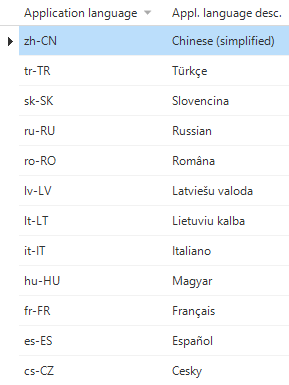 Application languages
TIP
To have the translation objects for a new language translated by an external party, use the Translations screen to export an existing language to Excel and then import the translated text to the new language.
Translation objects
For every translatable string, a translation object is generated for which a translation can be entered in the Translations screen or the Translation tab page found in many other screens.
Translation objects for new strings are automatically created when generating.
To manually generate translation objects for new objects, execute the Generate translation objects  task.
task.
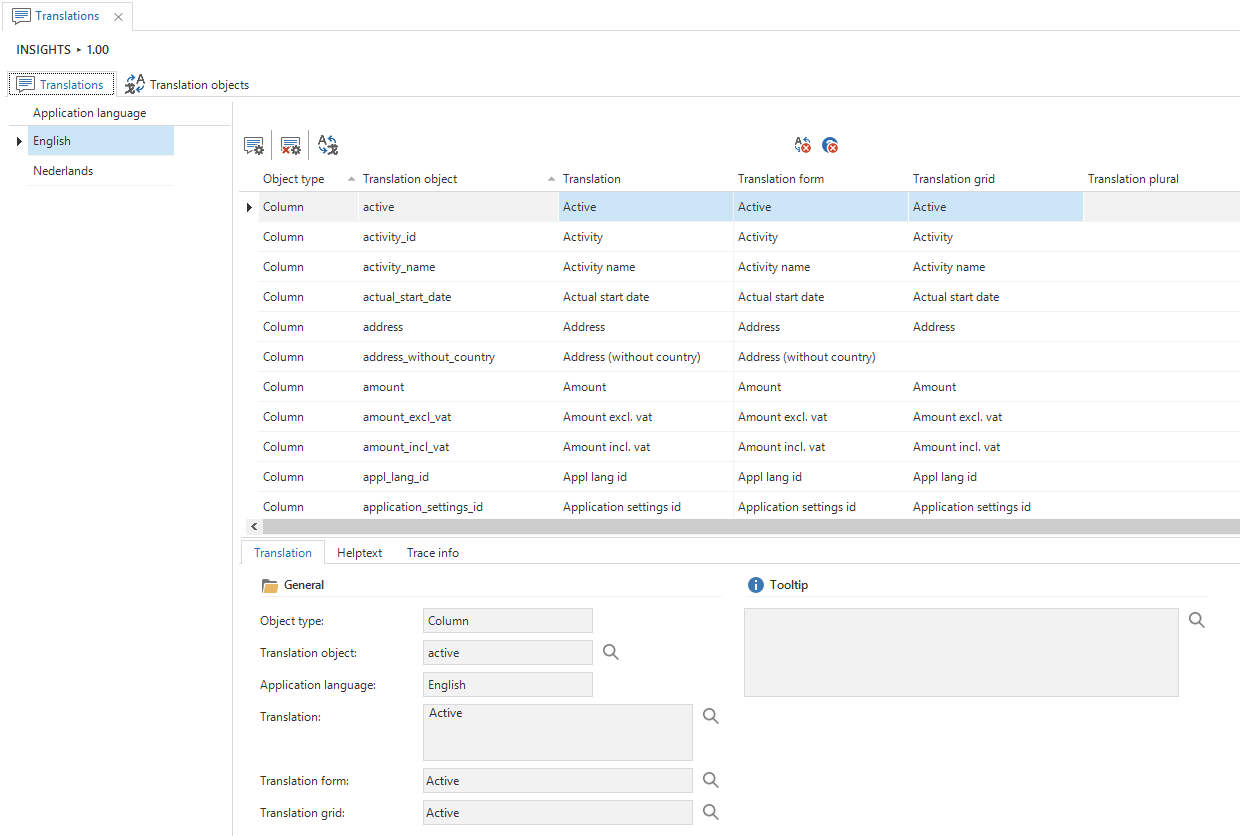 Translations screen
An object contains, at most, the following translations, depending on the type of translation object:
- (Single) translation
- Translation form
- Translation grid
- Translation card list
- Plural translation
- Tooltip text, shown when the mouse is moved over a field name, group name, tab or column. It is possible to use HTML to format the text.
- Help text
Untranslated objects can be translated semi-automatically with the Translate untranslated objects task. The task replaces underscores with spaces, removes the square brackets and changes the first letter to a capital letter. It is convenient to generate translations for the language in which the data model was written.
Link tables
With link tables that are displayed as detail, it is often desirable, depending on the context, to display another translation. This is possible by including the plural translations of both master subjects, separated by a forward slash / in the plural translation of the linking table. The GUI will show the part of the translation that is not equal to that of the current master table.
For example, by giving the linked table between person and company the translation Persons/Companies, the table will have the translation Companies under person and Persons under company.